
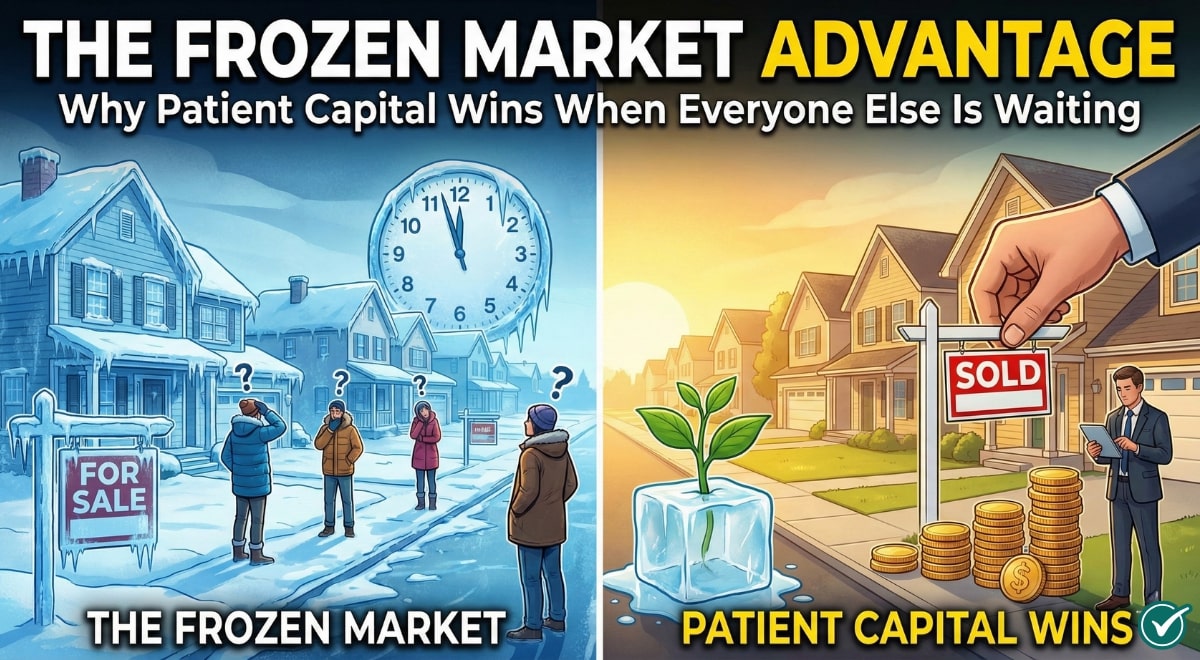
THE FROZEN MARKET ADVANTAGE: Why Patient Capital Wins When Everyone Else Is Waiting
When Slowness Becomes Opportunity
The narrative around the US housing market in 2025 sounds dire. Home price growth decelerated from 3.4% in January to just 1.1% by October—a decline that hasn't been seen since 2012. One-third of America's 100 largest metros are now experiencing year-over-year price declines. Washington D.C. saw inventory spike by a record 60% after federal sector layoffs. Inventory is up. Time on market is up. Price growth is stalling.
Most investors look at this data and do one of two things: they panic and stay on the sidelines, or they get aggressive chasing deals. Both approaches lose money. The third approach—the one Grit focuses on—is patient positioning in a slowing market.
A frozen market doesn't mean a broken market. It means a market repricing, and patient capital wins repricing contests.
The Data Layer Most Investors Miss
Here's what the headlines don't tell you:
1. Housing Wealth is at Record Levels—and Stable
Yes, housing wealth peaked in Q2 2025 at $48.6 trillion. But "peaked" doesn't mean "declining." It means the explosive growth phase is over, and we're in a wealth preservation and stabilization phase. For an investor thinking in 10-year horizons, that's actually ideal. You're not entering at a speculative peak; you're entering into a market where wealth is embedded and stable.
2. Investor Activity Remains Robust
In 2025 (through October), investors spent $483 billion on just under one million single-family homes—roughly 30% of all transactions. These aren't emotional buyers running from a crash. These are professionals who calculated the math, stress-tested the rental numbers, and deployed $483 billion despite slowing price appreciation. That conviction is worth noticing.
3. Rental Markets Are Softening—Which Creates Yield Opportunities
National single-family rent growth slowed to a 15-year low by October 2025. Sounds bearish, but it's actually a gift for disciplined investors. When rental growth slows while investor buying remains robust, it means investors are no longer buying for appreciation—they're buying for yield. This shift from speculative buyers to yield-focused buyers is exactly what creates long-term wealth.
Markets where investor participation is high and rent growth is slowing are markets in transition from speculation to fundamentals. Those transitions create 7–10 year compound returns for patient capital.
4. Regional Variations Create Opportunity Selectivity
While the macro market slowed, regional performance diverged sharply. The Washington D.C. inventory spike created challenges, but Texas, California, and the Mountain West handled price moderation more steadily. Florida's explosive 2021–2023 appreciation is normalizing, but coastal metros with employment diversity are holding value more resilient.
This regional divergence is good news for selective investors. It means the market is now rewarding disciplined suburb/corridor selection over the general "buy anything" approach that worked in 2021–2022.
What "Frozen" Actually Means for Investors
Let's define terms clearly:
-
A frozen market is NOT a declining market (prices down significantly)
-
A frozen market IS a stabilizing market where appreciation flattens and buyer selectivity increases
-
Frozen markets reward patient buyers and punish emotional ones
-
Frozen markets are when second-time buyers and investor profits are made
Here's why:
In Hot Markets (2021–2022): Any semi-decent property sells in hours at above asking. Investors make money through price appreciation alone. Rental yields matter less because the capital upside is so large.
In Frozen Markets (2025–2026): Price appreciation is modest or flat. But rental yields matter. Properties that generate 5–6% cash-on-cash returns become valuable. Locations with strong employment and tenant demand become critical. This is when discipline replaces luck as the primary driver of returns.
Investors who learned to evaluate properties for cash flow (not just appreciation) in the last few years have a massive advantage in 2025–2026. Those who still think like it's 2022 will continue to struggle.
The 2026 Outlook: Modest Recovery on Fundamentals
Cotality's forecast for 2026 is actually encouraging:
-
National home prices expected to rise ~3% (above the stall rate of 2025, but far from 2022 levels)
-
Gains concentrated in northeastern and midwestern markets (regions with employment stability, not speculation)
-
Affordability constraints and non-mortgage cost increases (insurance, property taxes) remain headwinds
Translation: The market is healing. Price growth is returning, but at sustainable rates. Regional diversity is the prize—Northeast and Midwest represent genuine employment and demographic strength, not just capital flow chasing prior gains.
For investors, this means:
-
Properties you buy in 2025 at flat/modest appreciation pricing will see 3%+ annual growth in 2026+
-
This compounds to 8–10% annualized returns when you add modest cash flow
-
You avoid the 2027–2028 downside that will hit buyers who chase momentum in 2026–2027
The Investor Thesis for Late 2025
Here's how Grit advises investors approaching this market:
1. Abandon Macro Calls, Master Micro Mechanics
You can't call whether the market will be up 3% or down 2% in 2026. What you can do is identify specific metros, corridors, and property types where the risk-reward is clear. Focus on:
-
Mid-sized metros (250k–1M population) with employment diversity and below-national-median valuations
-
Rental properties in neighborhoods with strong tenant demand and low vacancy
-
Tax-advantaged structures (1031 exchanges, cost segregation, opportunity zones) to amplify after-tax returns
2. Stress-Test Hard for Interest Rate Risk
Mortgage rates are likely to stay elevated (above 6% for a while). This means two things:
-
Buyers will remain price-sensitive and rent-focused
-
Any property you buy needs to make sense if rates stay at 6–7% for the next 5 years (not dropping to 4%)
Properties that work only if rates fall are speculation. Properties that work at 6% rates with 5%+ rental yields are investments.
3. Prioritize Cash-on-Cash Yield Over Capital Appreciation Potential
In 2025, a property generating 5–6% annual cash return (before appreciation) is valuable because appreciation is uncertain. In 2022, investors chased properties with 2% cash yield but 20% appreciation potential. That trade is dead.
Flip your priority: seek 5–6% cash yield in reasonable locations, add whatever appreciation comes, and compound over 7–10 years. This approach works in frozen, recovering, and accelerating markets. It fails only in crash scenarios—and crash scenarios are priced into today's valuations anyway.
4. Use the Slowdown to Build Systems and Networks
When the market was hot, finding deals was easy—everything sold. Now, sourcing discipline matters. Use 2025–2026 to build relationships with local brokers, property managers, and contractors. Develop underwriting processes. Create property management playbooks. Build referral networks.
The investors who win in recovering markets are the ones with systems and networks in place when the market accelerates. You're building that infrastructure now, while prices are stable and time is plentiful.
How Grit Positions US Real Estate Investors
From our headquarters at 142 West 57th Street in New York, Grit works with international and domestic investors to navigate this exact moment:
-
We identify metros and corridors where regional employment and demographic trends create 10-year wealth foundations
-
We stress-test cash flow across rate scenarios so you know the property works at 6%, 7%, and 5% rates
-
We evaluate market cycles to ensure you're buying into stable/recovering markets, not chasing peaks
-
We structure deals with tax efficiency in mind (1031 exchanges, opportunity zones, qualified business income treatment)
-
We build management systems so you can scale from 1–2 properties to 10+ with confidence
The frozen market isn't your enemy. It's your advantage—if you approach it with discipline, not emotion.
Ready to position for the recovery with professional guidance? Contact Grit Property Group USA: +1 646-325-2270 or visit our New York headquarters at 142 West 57th Street to discuss your 2026 positioning strategy.