
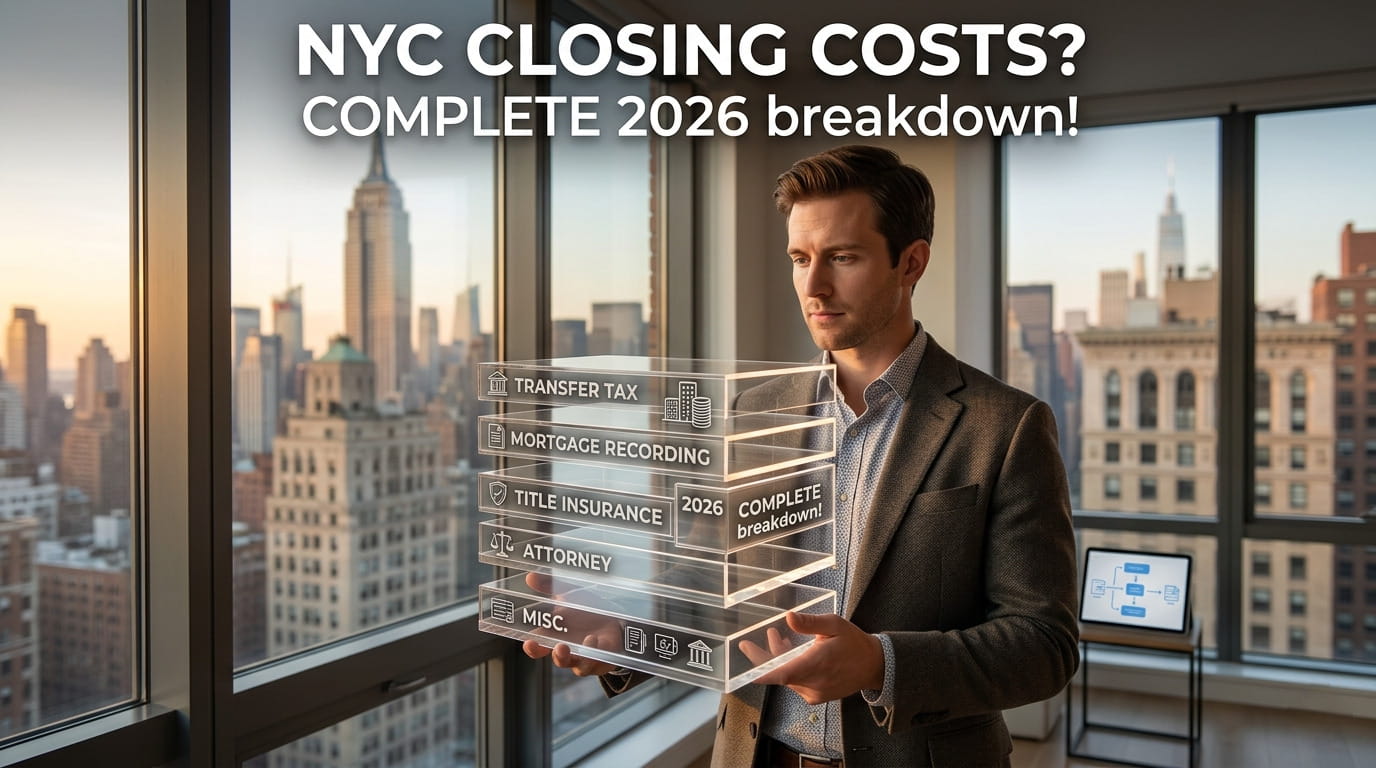
How Much Are Closing Costs NYC? A Complete 2026 Buyer's Breakdown
Purchasing New York City real estate marks a monumental milestone. However, the apartment's sticker price only begins the financial transaction. Buyers consistently make one incredibly expensive mistake. They fail to accurately budget for closing costs in NYC.
Typical American housing markets see closing fees hover around 2% to 3%. Buying property in the five boroughs changes the rules entirely. A unique set of municipal and state taxes drastically inflates your required cash-to-close. Depending on property type and financing, closing costs NYC range from 1.5% to a staggering 6% of the purchase price. This comprehensive 2026 guide breaks down every single line item awaiting you at the closing table. Discover exactly how to secure your dream home without last-minute financial panic.
1. The Mansion Tax: The Heaviest of Closing Costs NYC
Does your purchase price hit $1,000,000 or more? New York State immediately hits you with the Mansion Tax. The buyer pays this progressive transfer tax. You cannot avoid it.
The rates scale aggressively:
- $1M to $1.99M: 1.00%
- $2M to $2.99M: 1.25%
- $3M to $4.99M: 1.50% (Rates scale up to 3.9% for properties over $25M).
Imagine you purchase a $2.5 million condo. The Mansion Tax alone adds $31,250 to your closing costs in NYC. Buyers hit this threshold easily in Manhattan. Many active buyers explore the best NYC neighborhoods for first-time buyers under $1M in 2026. This highly popular strategy helps them completely dodge this hefty tax burden.
2. Mortgage Recording Tax (Condos and Townhomes)
Do you plan to finance a condominium or townhouse? You must pay the Mortgage Recording Tax (MRT). The state calculates this tax strictly on your loan amount, not the purchase price.
- For loans under $500,000, the MRT equals roughly 1.8%.
- For loans of $500,000 or more, the MRT hits 1.925%.
Cooperative apartments (co-ops) enjoy a massive exemption from the Mortgage Recording Tax. You buy shares in a corporation rather than real property. Therefore, you record no traditional mortgage. This crucial exemption explains why co-op closing costs NYC sit much lower. They often land between 1.5% and 3%. Condo costs typically consume 4% to 6%.
3. Title Insurance and Attorney Fees
Lenders legally mandate title insurance if you finance a condo or townhome. This protects their investment against past liens. Experts highly recommend title insurance even for all-cash buyers. New York strictly regulates title insurance rates. Expect it to cost roughly 0.4% to 0.5% of the purchase price. Co-ops do not require traditional title insurance. They only trigger a smaller "lien search" fee.
Additionally, New York operates as an attorney-state. You cannot close a real estate transaction without legal representation. Real estate attorney fees typically range from $3,000 to $5,000. Complex deals involving LLC purchases require more paperwork and push these fees higher.
You must master the art of negotiation to protect your investment strategy. Review our guide on buying property in New York City without overpaying: 5 smart steps for 2026. This teaches you how to negotiate seller concessions to heavily offset your closing expenses.
4. New Development Surcharges
Are you buying a brand-new condo directly from a developer? Prepare for the highest closing costs NYC has to offer. Developers legally pass the State and City Transfer Taxes onto the buyer. Sellers usually pay these taxes in normal transactions. These transfer taxes total roughly 1.825% of the purchase price.
Combine these transfer taxes, the Mansion tax, and the MRT. Closing on a new development easily consumes 5% to 6% of your total budget.
However, existing resale properties escape this burden entirely. Historic properties offer rich character and drastically lighter closing fees. Consider purchasing a stunning resale townhome like 555 Hudson Street, New York, in the West Village. Or explore a classic pre-war condo such as Apt 3N, 222 West 14th Street, New York. In these deals, the seller absorbs those massive transfer taxes. Your cash-to-close remains highly manageable.
Conclusion: Planning Your Cash-to-Close
Proper financial modeling eliminates the sticker shock of closing costs in NYC. Understand the exact thresholds for the Mansion Tax. Calculate your specific Mortgage Recording Tax accurately. Acknowledge the stark financial differences between buying a co-op, a resale condo, or a new development.
This knowledge empowers you to forecast your exact cash-to-close requirements. An experienced real estate team will hand you a detailed "Good Faith Estimate" long before you sign a contract. You will never experience a blindside at the closing table.
Ready to take the next step? The expert team at Grit Property USA is here to guide you. Whether you're buying your first home, investing, or exploring your options — contact us today.